How to Find Old Versions of Any Website on the Wayback Machine
The Wayback Machine is the search and browse tool for the Internet Archive, a nonprofit that has been crawling and storing snapshots of public web pages since the 1990s. The Internet Archive was founded in 1996, and the Wayback Machine opened up to public search a few years after that. It does not capture every page on the internet, and it cannot see anything sitting behind a login, but for a public site that has been online for a while, there is usually more history in there than people expect.
Two things determine how much of a site it holds. The first is how often crawlers found and followed links to it, which correlates loosely with how well known and well linked a site was. The second is whether the site ever blocked crawlers, since a robots.txt file that excluded archiving will leave gaps in the record for the period it was in place.
Searching for a specific page versus an entire domain
This distinction trips up more searches than anything else. Searching the exact address of one page shows you the capture history for that single URL only. Searching just the domain name, with no path after it, surfaces a broader view of what the Archive holds for the site as a whole.
| What you type | What you get back |
| example.com | Domain level history, the usual starting point |
| example.com/about | Capture history for that one page only |
| www.example.com | A separate history from the non-www version |
| example.com/page?utm_source=… | Often nothing, tracking parameters rarely match a capture |
Keeping the search as simple as possible tends to work better than pasting a long URL copied from an email or an ad. Strip anything after a question mark before searching.
Reading the snapshot calendar
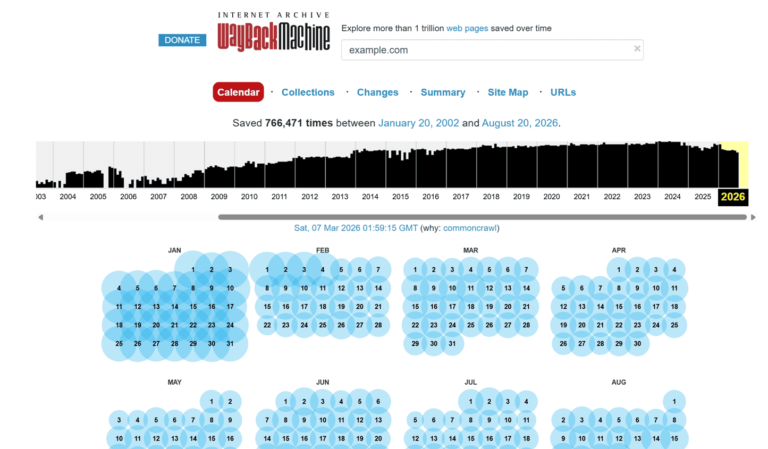
Once you search a URL, the Wayback Machine opens a calendar view. A bar across the top lets you jump between years and gives a rough sense of how often the page was crawled during each one. Below that, a monthly calendar shows individual days, with a marker on any date that has at least one saved snapshot. Busier dates are usually easy to spot, since the marker looks heavier than a day with just a single capture. Click a date, then click the specific timestamp that appears, and the page loads exactly as it looked at that moment, old banner, old layout, and all.
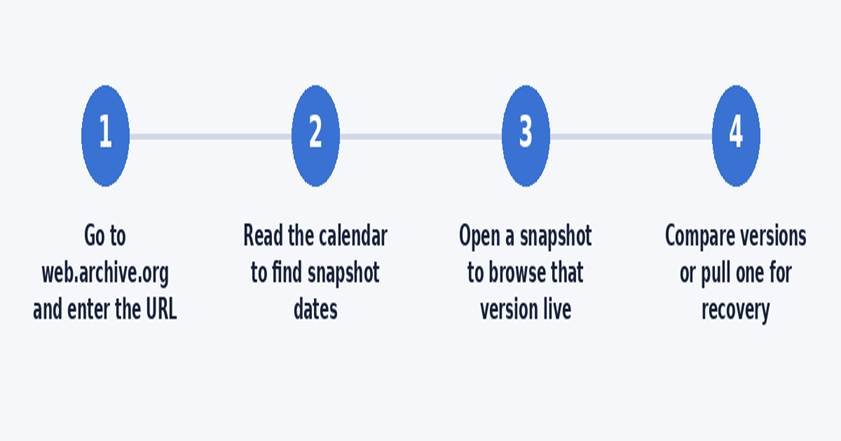
The basic flow for looking up any page’s history.
A few quirks are worth knowing. Snapshot dates reflect when the crawler visited, not when the page changed, so a page that sat untouched for two years will look identical across dozens of captures. Archived pages also often load slowly and may show broken images or missing styling, because each asset has to be fetched from its own separate capture, and those were not always taken on the same day.
A few searches worth trying
- Your own old domain, to see designs and content from years ago.
- A competitor’s pricing or homepage from before a rebrand, to see how their positioning shifted.
- A news article or blog post that was quietly edited after it was first published.
- A product page, to check when a claim, price, or feature first appeared.
- A supplier or partner’s site from the period a contract was signed.
- A domain you are thinking of buying, to see what was published on it before.
That last one is worth a moment. Expired domains sometimes carry a history the current listing does not mention, and the archive is the fastest way to see what a domain was actually used for before it went on sale.
Comparing two versions of the same page
Finding one snapshot is straightforward. The more useful trick is putting two side by side to see what actually changed, which is where most research questions really live.
The simplest method needs no special tools. Open two snapshots from different dates in separate browser tabs and switch between them. Differences in headline wording, pricing, and calls to action tend to jump out immediately when the layout stays still and only the text moves. For text heavy pages, copying both versions into a plain document and comparing them line by line catches the smaller edits that visual scanning misses.
Note the full snapshot URL for each version you are comparing. It contains the exact capture timestamp, which is what makes the comparison verifiable by someone else later rather than just something you saw once.
Saving a page to the archive yourself
The Wayback Machine also runs in the other direction. Its Save Page Now tool takes a URL and captures the page on the spot, which is useful when a page is live today and you suspect it will not stay that way.
- Capturing a page before you ask for a change, so there is a record of what it said first.
- Archiving your own site before a redesign or migration, so the old version exists somewhere independent.
- Preserving a source you are citing, so the reference still works if the original moves.
- Recording a supplier or partner page at the moment terms were agreed.
A capture you make yourself is only as old as the day you made it, so it proves what a page says now, not what it said last year. That distinction matters most when a page’s history is genuinely contested.
When the calendar comes up empty
Not every domain has rich coverage. Brand new sites, very low traffic pages the crawler never prioritized, and sites that blocked crawlers at some point can all show a thin or empty calendar. If you searched your own site and got nothing at all, that is common enough that it has its own troubleshooting guide on what to do when the Wayback Machine is not showing your site, which covers URL variations, robots.txt exclusions, and how to query the Archive’s full capture index directly.
Browsing history versus recovering a whole website
Everything above is about looking at one page at a time in your browser, which is perfect for research, comparisons, or settling an argument about what a page used to say. It is a different task from pulling an entire site back into working files you can host again.
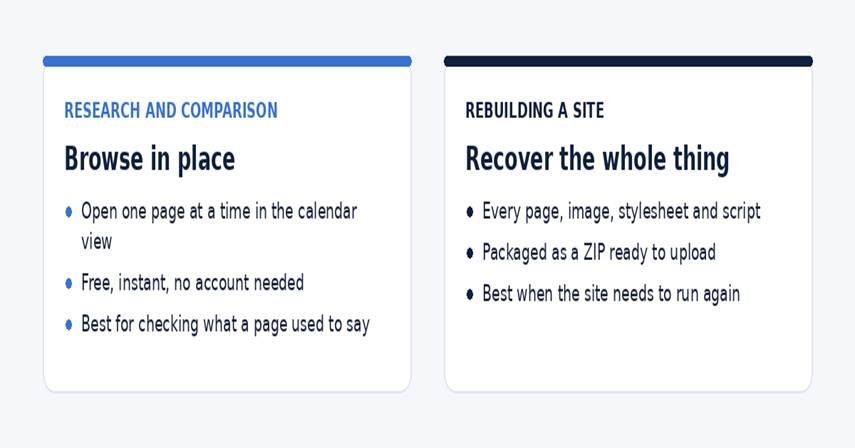
Two different jobs. Which one you need decides whether browsing is enough.
Saving an archived page from your browser gets you that one page, usually with broken links and missing assets, because the images and stylesheets live at separate archived addresses. Recovering a site properly means resolving all of that across every page. RecoverYourSite’s recovery tool automates that work and returns a ZIP you can actually upload, and the full download walkthrough covers exactly how the process works, screenshots included. Page limits and link expiry for each plan are listed on the pricing page.
If the old site needs to come back as something you can actually edit rather than static files, the manual services cover rebuilding a snapshot into WordPress, recovering written content on its own, and reviving an expired domain. And if you are standing up a recovered site somewhere new, the recommended tools page lists hosting, domain, SSL, and backup options grouped by which stage of the process you are at.
Frequently asked questions
Do I need an account to use the Wayback Machine?
No. Searching and browsing archived pages is free and does not require signing up for anything. An Internet Archive account is only needed for some contributor features, not for looking things up.
How far back does the coverage go?
As far back as 1996 for some of the earliest captured pages, since that is when the Internet Archive began. Coverage for any specific site varies enormously. A major news site might have thousands of snapshots, while a small personal blog might have a handful, or none at all.
Can I just save a page directly from the browser view?
You can print or save an individual page manually, but that only captures what is visible in that one view. It will not include every linked asset or page needed to actually host the site again, which is the gap a purpose built recovery tool closes.
Why do archived pages look broken or unstyled?
Because each asset is fetched from its own capture. If the stylesheet was captured on a different date than the page, or was never captured at all, the layout falls apart even though the text is intact. This is normal and does not mean the content is lost.
Can I see a page that was deleted years ago?
Yes, provided it was public and was crawled before it was removed. Deleting a page from a live site does not remove earlier captures of it from the archive.
Is it legal to look at and use archived pages?
Viewing and citing archived pages is routine and unremarkable. Reusing someone else’s content is a separate question governed by ordinary copyright, and the legal side of downloading from the Wayback Machine covers where the line sits.